
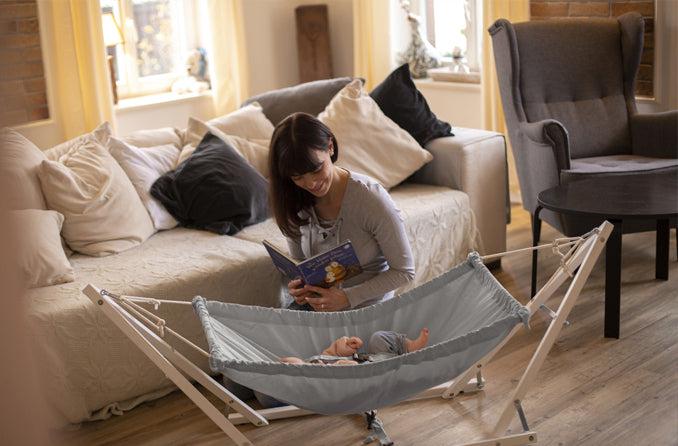
Hammocks are a wonderland for kids; they’re fun to climb onto and comfy to swing on. Children enjoy the bright colours and gentle movement above ground. They also have benefits for children with autism, as the swinging motion helps to restore the vestibular system. Whilst all our hammocks have globally recognised safety certifications, our health and safety experts do not recommend leaving your child unsupervised.
We’ve put together a basic guide to child-friendly hammocks so that you can minimise these risks and make sure that your kids can safely enjoy their hammock. Of course, different types of hammocks are suitable for different ages, but luckily Simply Hammocks offers hammocks suitable for babies, toddlers and older children.
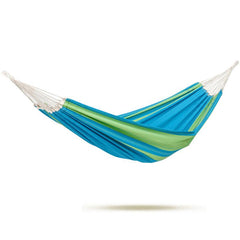
Often, children’s hammocks do not have nets or ropes, which can pose a risk for your child’s fingers to get stuck in. Brazilian-style hammocks, such as this one, as pictured below, are a great choice as they don’t have any of these cords, nettings, or loops, but they are sturdy and comfortable. Children’s hammocks also do not use spreader bars, which makes the hammock more taut and increases the risk of it flipping over.
Safety Tips:
1) Don’t leave your kids unsupervised
Make sure that you are always close by. This is particularly important in the case of younger children, as infants should not play in a hammock unsupervised.
2) Don’t hang the hammock too high
As a rule of thumb, don’t hang a hammock higher than you are willing to fall. For children, a good height would recommend a maximum fixing height of 1.5 metres off the ground for fixings to hold the hammock. Though this is dependent on the type of hammock, we recommend non-spreader bar hammocks for children. The natural cocooning effect of the hammock, when hung with more slack, can allow the excess side material to act as a barrier of sorts.
Click the image below to see our buyer's guide.

3) Don’t hang the hammock on a slope, above dangerous terrain, or near water.
This goes without saying, but make sure to hang your hammock in a suitable place. If you’re hanging indoors or over a hard surface, you could put some padding on the floor to make for a softer landing. Alternatively, a good idea might be to hang your hammock above a sand pit in case of falls.
4) Inspect the hammock for damage, frays, tears, and weakened equipment.
Each time you hang your hammock, make sure that there is no damage, particularly if your hammock has had extended usage. If you do not take down your hammock and leave it hung up, make sure to check frequently to ensure maximum safety should a child be using it unsupervised. We have plenty of sources on how to look after your hammock on our aftercare page.
5) Teach your kids how to safely use a hammock.
This includes safely getting in and out of the hammock, no jumping or standing in the hammock and don’t get in the hammock with your feet first. Here is a guide for helping you get into a hammock safely.
There may be some other considerations depending on your situation, for example, if you are going camping, you might want to consider something such as a mosquito net, insulation, such as blankets, and storage. If you need help choosing a hammock or talking through which accessories you might need, then you can watch our video, look at our buyer's guide, use our hammock finder tool, or speak to a hammock expert on 01748 471 299.


